

How To Draw Human Pictograms In Illustrator
Over the years, Adobe Illustrator has become one of the tiptop applications for creating vector illustrations. There is nearly nothing you tin't make in Illustrator. It is a powerful tool for creating vectors for all kind of logos, websites, icons, business concern cards, impress materials, etc. Ane of the best features of the vector format is its ability to scale up or down to any size without any loss in quality (dissimilar raster illustrations).
But let's not forget that Adobe Illustrator is complex software. Despite all of its advantages, Illustrator demands a lot of skill, work, time and patience. The software will not generate effects automatically; excellent effects are the issue of trying and testing different settings. Trial and error is an effective method in achieving the desired outcome. Creating realistic vector illustrations in Adobe Illustrator tin can be fun, but it can also give yous a headache if y'all can tell something'southward missing from an illustration only don't know how to get it.
Hither is a list of things to consider when creating stunning vector illustrations:
- Perspective,
- Polish lines,
- Colors,
- Border highlights,
- Reflections,
- Shadows.
Stick To Perspective
When it comes to cartoon realistic vector illustrations, perspective is paramount in importance. If y'all ignore perspective, the illustration will look flat and distorted and lack depth.
The most important aspects of perspective are size and altitude. The further away an object is, the smaller information technology will appear, and vice versa. By increasing and decreasing size in this way, you tin can accomplish good depth in your illustrations.
At that place are a several methods of drawing perspective.
Perspective Grid
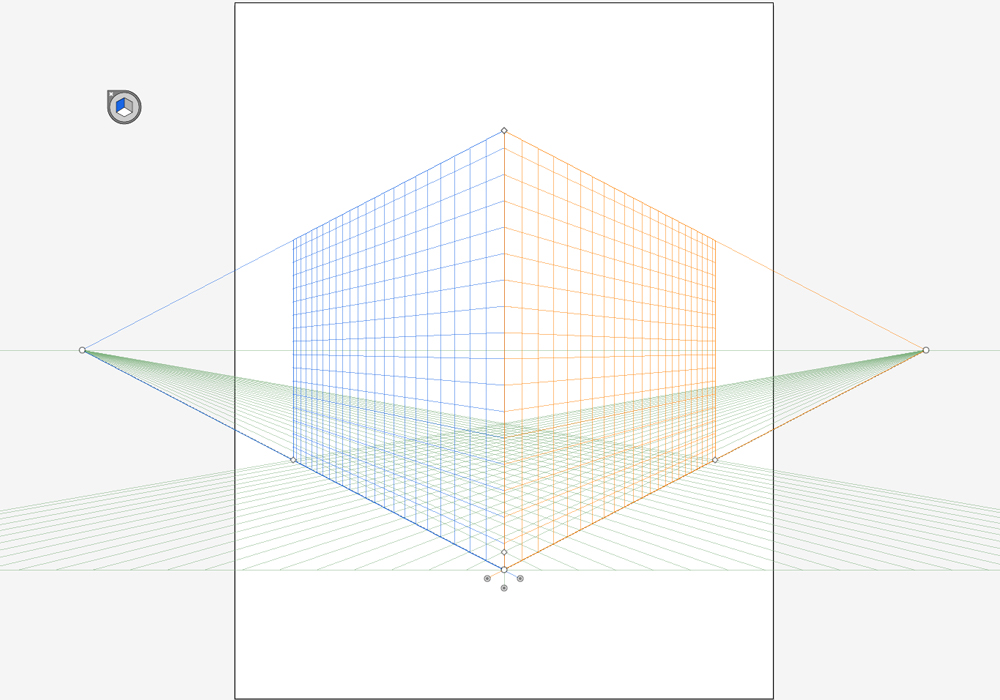
Ane very useful way is to utilize a perspective grid, which is a new feature in Illustrator CS5. Establishing a horizon and the vanishing point is function of this. The perspective grid in Illustrator is an editable tool, so it can be adapted to adjust i'south purpose. You can alter the perspective just by dragging the corner nodes of the filigree. You tin can make the vanishing betoken longer or shorter and alter the number of boxes in the filigree. Existence able to adapt the working surround to your needs will make it easy for you to do advanced drawings.
Extrude and Bevel
Some people have trouble seeing and presenting perspective in the kickoff place. In this instance, I would recommend "Extrude and Bevel," which is a convenient tool for creating 3-D objects. Yous can set a value for "Perspective" in the "Extrude and Bevel" options box (either type in a value or drag the slider over). Expanding an object will make it editable. Because the Extrude and Bevel issue gives you an object with many parts and ballast points, it is highly recommended that yous use that object as the reference for tracing with the Pen tool (P). This mode, you'll create clean and unproblematic vector illustrations without any unwanted parts or any ballast points that are an obstruction in the printing procedure.
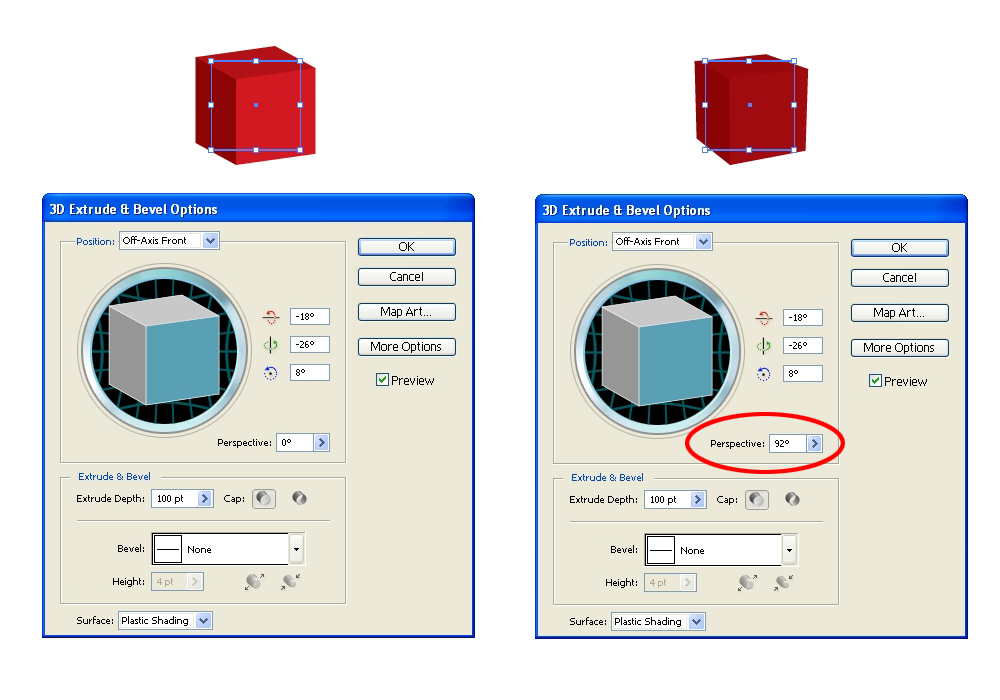
If yous take imagination and some skill, you will be able to draw an illustration based on an estimation of perspective. Of course, this method is non quite precise.
Simply adding perspective alone is plain not enough to create stunning artwork.

Using The Pen Tool For Smoother Lines
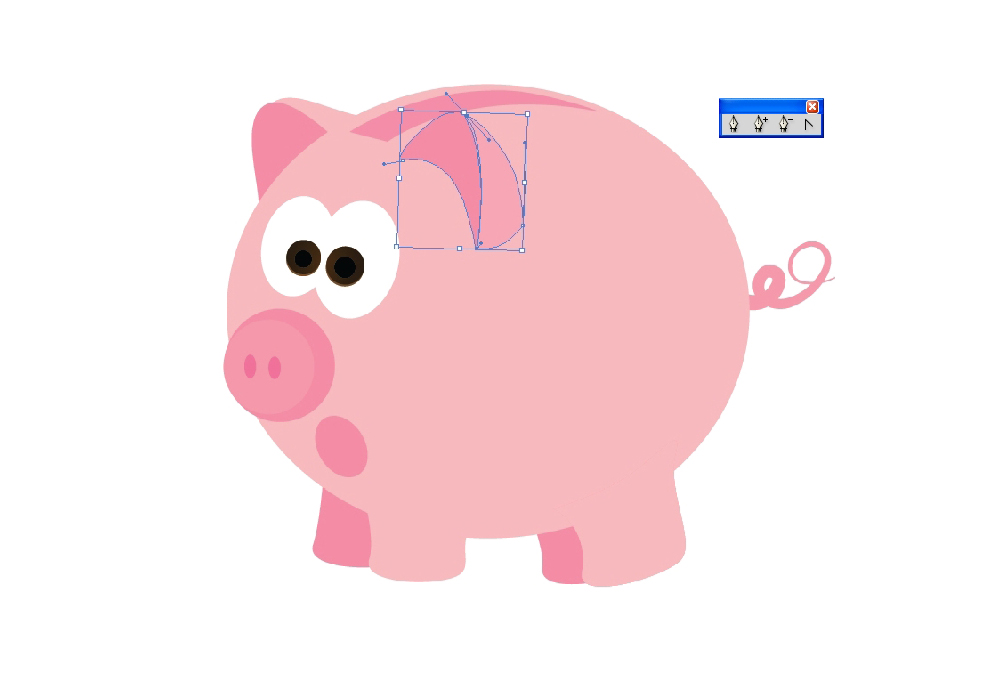
Creating shapes in Illustrator shouldn't be complicated. To draw paths and curves, either use the Pen tool (P) or simply combine objects with Pathfinder features such as "Unite," "Minus Front," "Subtract," "Intersect," etc. Considering the paths comprise numerous anchor points, you volition have to adjust them to create smooth lines. Anchor points are highly editable and can exist adjusted with a few fantabulous tools. You can change the position of the path just by editing one anchor point. This takes a lot of practice; you'll need a steady paw and patience.
Alive tracing is one effective way to create vector illustrations. Try to complete a drawing with equally few ballast points as possible; avert adding ballast points at shorter intervals just to maintain the smoothness. To get smooth lines, make sure that the handle of the anchor indicate forms a tangent on the bend (i.east. inner or outer tangent). You tin always add or remove anchor points by going to the "Add together Anchor Point" (+) and "Delete Anchor Point" tools (-).
"Convert Anchor Bespeak" (Shift + C) allows you to make changes on the anchor points themselves. With this amazing tool, you will be able to modify the angle of the handle, thus enabling you to modify the path of the lines. Whereas adjusting simply one side of the handle will effect in an athwart shape.
Coloring
This part of the creative procedure is quite fun, but yet demanding. Choosing the correct colors can be a challenge. Commencement, you have to determine what style you want. Gentle and pastel colors might piece of work for retro illustrations, which would be rather simple and two-dimensional.
If y'all want to get photo-realistic, you lot might want more than vivid colors. Good dissimilarity can brand the artwork stunning. If yous don't know how to mix and match colors, Adobe has a great website with color swatches and beautiful combinations.
There is as well a swatch library in Adobe Illustrator, where you can find a lot of useful swatches and fifty-fifty create your own and salvage for future projects.
Gradients
When information technology comes to coloring, applying linear and radial gradients is the best way to prove light sources and to requite depth to your artwork. Establishing the position and bending of the light source is the start step in the coloring process. Shadows and highlights should be added co-ordinate to the source of the lite. Dark colors will simulate shadows and shade, while light colors will create highlights.
Besides creating shadows and highlights, gradients are the dandy mode to simulate shape. Using color, you can requite book to an object or grapheme. Apply every bit many colors equally yous'd like to build a slope, but just alloy them well; otherwise, you'll end upwards with harsh colour transitions. If you tend to blend colors effectively, and then try out the different "Blending Modes," such equally "Multiply," "Overlay," "Screen" and "Light."
Linear gradients are mostly used to present a plane. Radial gradients are suited to ovals and round shapes.

Transitions between colors in gradients can be shine or sharp. Smooth transitions are user-friendly for representing shade, shapes and forms. Sharp transitions are good for simulating gold, steel, chrome and other metals (i.due east. for representing the reflection of low-cal on these metals).
Gradient Mesh Tool
Because gradients are express to linear and radial shapes, nosotros sometimes take to detect ways to use gradients in anarchistic ways. Creating a gradient for an irregular shape is complex, because it involves blending colors between uneven forms with the employ of linear and radial gradients. This can be a lot of piece of work, but the Gradient Mesh tool is handy for this purpose.
The Gradient Mesh tool is a powerful tool that enables you to split up whatsoever part of an object by adding editable points and applying solid colors to those points. This way, you are able to create a gradient that follows the bodily shape of the illustration.
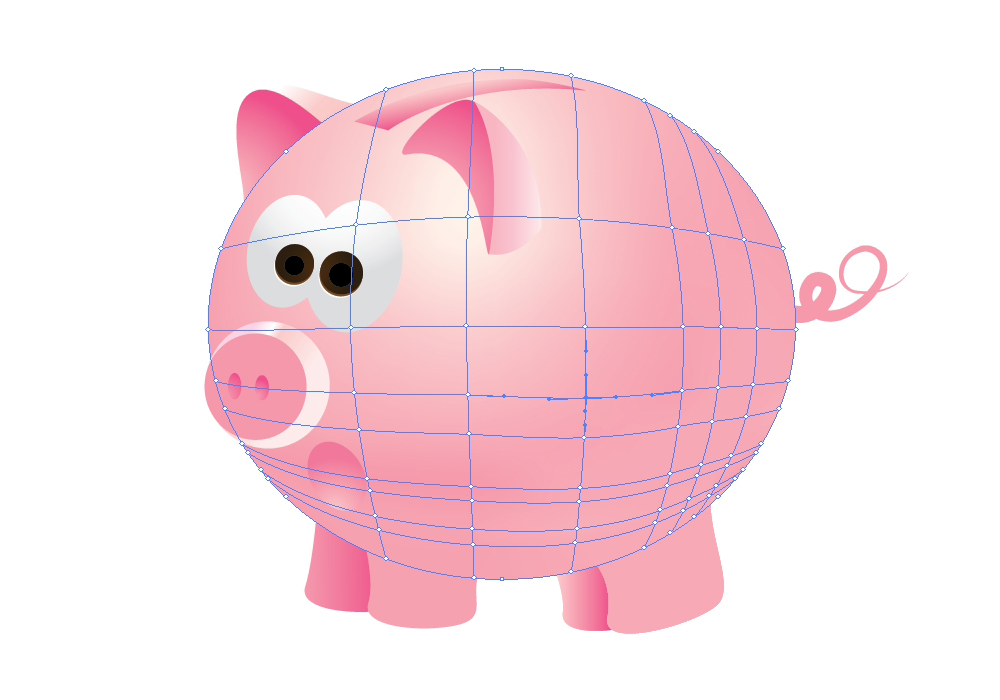
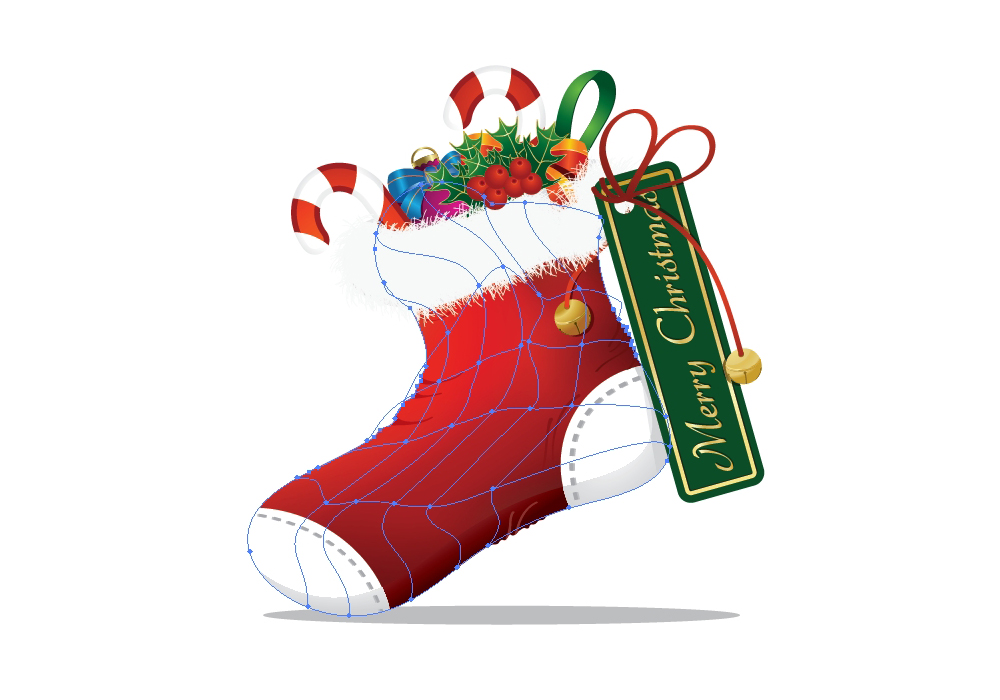
While gradients make illustrations more realistic, in that location is always room for improvement. A great illustration is made up of many well-integrated details. Mixing and matching colors and shapes is not piece of cake, just it does lead to a beautiful result.
Highlighting The Edges
When you are washed with the gradients, your illustration should exist gear up for some overnice edges. There are a few means to create them. If your analogy has straight edges, the best fashion to highlight them is with the Pen tool (P). This enables y'all to create simple shapes that can be blended (via gradients) with the rest of the illustration. Or you tin create a precipitous white border and plough information technology into the reflection using a low-opacity setting. Either way, you will be emphasizing the shape of the object.
Creating a highlight for curves is not much different. The most important affair is to make the shape of the highlight follow the shape of the object. The Pathfinder panel has a lot of features for creating curved highlights; doing it with the Pen tool solitary would exist tricky.
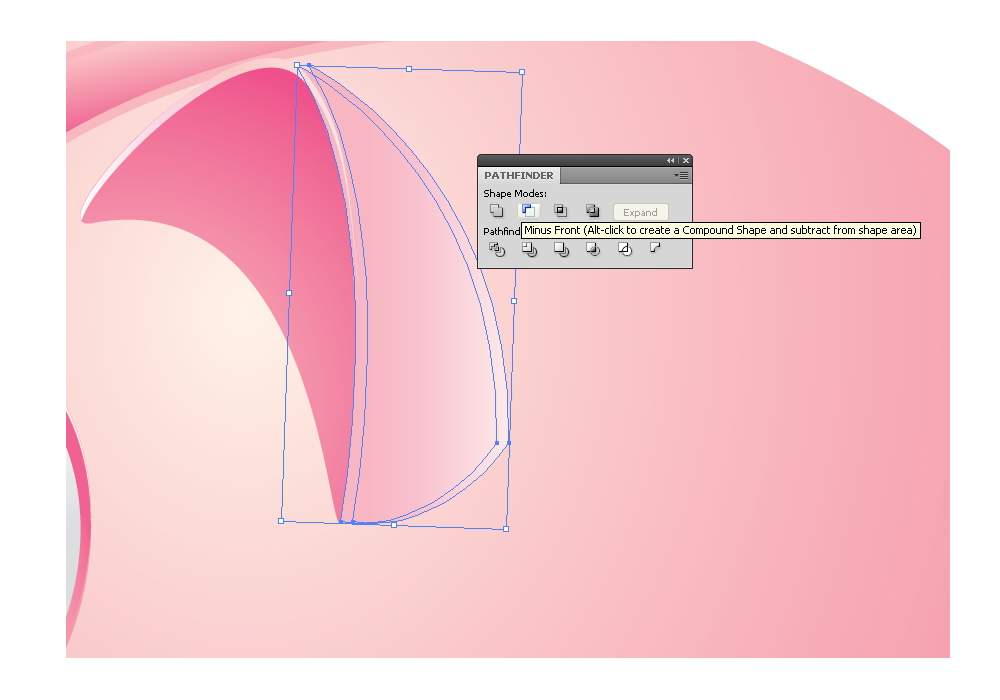

Reflections
Besides edge highlights and shade, low-cal sources can create many reflections and shadows. Take a expert look effectually you lot and you'll run into all kinds of reflections: on glass, plastic, wood, metal, dirt, even in liquid. Reflections come in various forms. The nigh of import thing, once again, is to follow the shape of the object. For those skilled with the Pen tool, curved highlights shouldn't be a trouble. If you are unsure how to depict highlights with the Pen tool, try combining dissimilar shapes in the Pathfinder panel.
Even though the about common colour for reflections is white, with reduced opacity, try out different color combinations.

Highlights are useful for showing off the material of an object. With a conscientious color combination and reflections in the right places, you tin can simulate the await of a surface quite well. The event is a nice illustration with a sleeky surface.
The Last Touch on: Shadows
The main purpose of a shadow is to create an illusion of three-dimensionality. Without shadows, the analogy is non really complete. The shadow "defines" the illustration in a style. Like reflections, shadows are created past the influence of lite sources. The intensity or softness of the shadow depends on the distance between the object and the light source. A calorie-free source above an object volition comprehend almost the entire object. Uncovered parts of the object will cast shadows on surfaces below and on objects nearby.
You tin create a shadow with a solid color (for a sharp shadow) or with a linear or radial gradient (for a soft shadow).

If your object is complex, the best way to create a shadow that follows the entire shape of the object is to utilize the Blending tool.
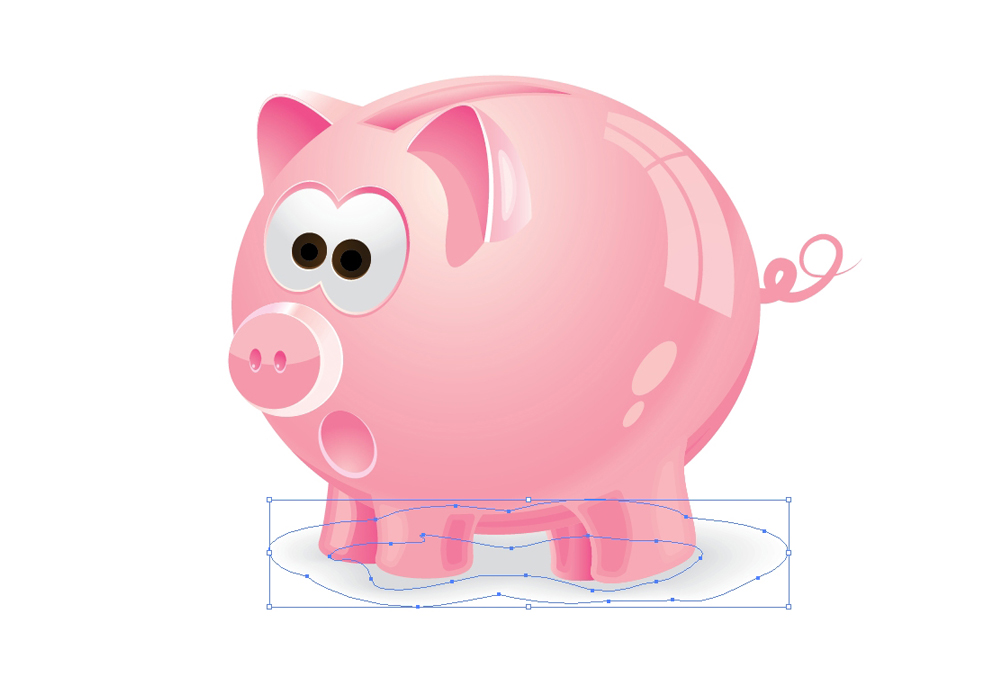
There is ane dominion almost the Blending tool, and that is to create two objects or paths with the verbal same number of anchor points. This way, you ensure that every anchor point on i object (or path) has a corresponding anchor point on the other object (or path). The issue will be a shadow with nice color transition.

Summary
Although there are only six rules to follow, there is the danger of too much detail. Endeavour not to exaggerate the details, or else the illustration could expect messy and overcrowded.
Low-cal is your greatest ally. It will lead you lot through the whole creation process, connecting the different parts of the illustration and making them come alive.
But go along the analogy elementary and make clean to minimize mistakes.
(al)(rb)
This article is originally published on Nov 07, 2011, and updated on Jul 24, 2020.

How To Draw Human Pictograms In Illustrator,
Source: https://www.jotform.com/blog/tips-and-tricks-increase-the-realism-of-your-vector-images-in-adobe-illustrator/
Posted by: schuetzprould.blogspot.com
0 Response to "How To Draw Human Pictograms In Illustrator"
Post a Comment